IDENTIFYING THE TIPPING POINT FOR PSYCHOSOCIAL RISK
The background
As awareness of psychosocial risk grows — and with new legislative changes in play — energy infrastructure company APA saw an opportunity to go beyond compliance.
The challenge wasn’t simply to embed a new psychosocial risk management protocol. It was to create a shared understanding of what psychosocial risk actually is — and what to do about it — across a complex, dispersed and safety-critical workforce.
The CHALLENGE
In response to changes in Australian Workplace Health and Safety legislation, APA developed a Psychosocial Risk Protocol — outlining minimum standards for identifying and managing psychosocial risk across the business.
But putting it into practice required more than a document.
APA’s frontline teams are experts in managing physical risks — but psychosocial risks like fatigue, workload, remote work, and interpersonal conflict can be harder to spot, and even harder to talk about.
With a geographically dispersed workforce — including many remote and isolated workers — APA’s Health, Safety, Environment and Heritage (HSEH) team needed a way to:
Build awareness of psychosocial risks
Share knowledge about the different types and how they interact
Reinforce that knowledge in the flow of everyday work
And most importantly, make it resonate.
OUR approach
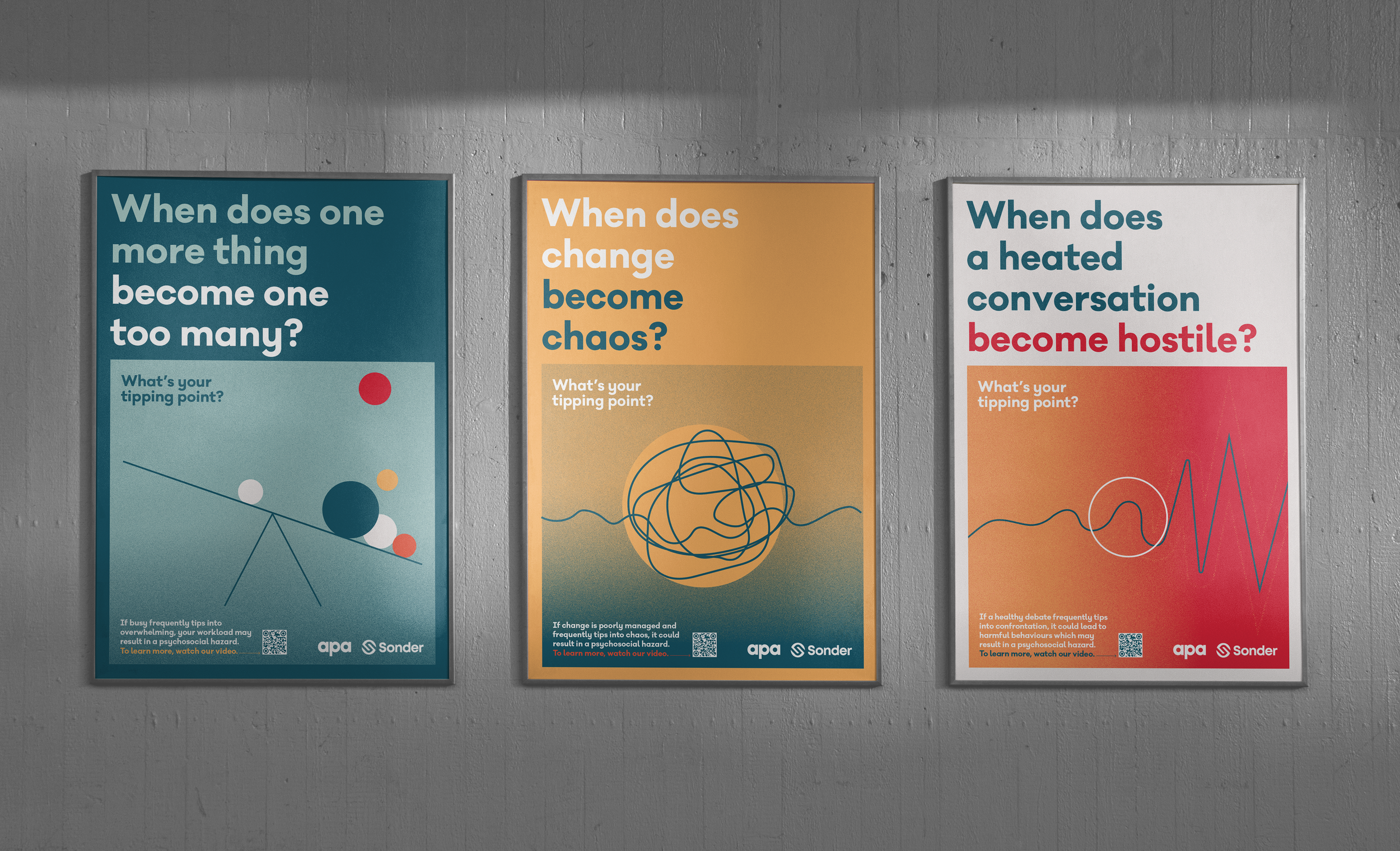
Together, we designed a three-phase communications and learning campaign called The Tipping Point — a concept that acknowledges that psychosocial risk is personal, cumulative, and context-dependent.
What pushes one person over the edge might not affect another — and often, it’s not one big thing, but a mix of smaller stressors that add up over time.
The program rolled out in three key phases:
1. Awareness
We kicked off with visual prompts across APA depots and offices, designed to spark curiosity — posing simple, human questions about pressure, isolation and stress.
These linked to a short animation explaining psychosocial risks in relatable terms, supported by a Leader Guide to help people leaders facilitate conversations.
2. Knowledge
Next, we delivered a microlearning module featuring practical scenarios, knowledge checks, and real-world context. This helped employees understand how work design and behaviours contribute to risk — and what to do about it.
3. Reinforcement
To complete the loop, we revisited the original questions with environmental collateral that reinforced the learnings — offering clear, actionable steps for recognising and responding to common psychosocial scenarios at APA.
Throughout, the focus was on making the content accessible, relatable and relevant — never abstract or overwhelming.
The impact
Early after rollout, it was clear The Tipping Point had begun to shift awareness and engagement.
Environmental prompts were deployed across APA depots and offices
Workers reported increased curiosity and connection to the materials
The campaign helped break habituation — encouraging people to stop, reflect and talk
Leader engagement lifted, with tools to support meaningful conversations
Of the first 700 participants to complete the learning module, the average rating was 4.5 out of 5.